Flight disruptions can turn a carefully planned journey into a frustrating ordeal. For travelers departing from Europe or the United States, a single delay or cancellation can trigger missed connections, unexpected costs, and major inconvenience. Understanding the core issue—how flight disruption interrupts airline operations and affects passenger rights—is crucial to claiming what you deserve. This guide breaks down what truly counts as disruption, reveals your compensation options, and shows you the fastest way to get your money back.
Table of Contents
- Defining Flight Disruption In Air Travel
- Major Types And Common Causes
- How Flight Disruption Affects Passengers
- Legal Rights And Compensation Explained
- Mistakes To Avoid And Recovery Steps
Key Takeaways
| Point | Details |
|---|---|
| Understand Disruption Types | Familiarize yourself with flight delays, cancellations, and denied boarding to know your rights to compensation. |
| Document Everything | Keep detailed records of all communications and expenses related to the disruption for potential compensation claims. |
| Know Your Compensation Rights | Be aware of the legal protections applicable to your situation, especially differences between regions like the EU and the U.S. |
| Act Immediately | Take prompt action to communicate with airlines, request written documentation, and initiate compensation claims without delay. |
Defining Flight Disruption in Air Travel
Flight disruption sounds straightforward until it happens to you. It’s when your planned flight gets derailed from its scheduled timeline—whether that means it doesn’t depart on time, gets canceled entirely, or takes an unexpected route.
Flight disruption occurs when unexpected factors interrupt airline operations, forcing airlines to deviate from their normal schedule. These interruptions range from minor delays to complete cancellations, and they happen more often than you might think.
The core issue is that airlines operate on razor-thin margins with interconnected schedules. One delayed flight can trigger a chain reaction affecting crews, aircraft, and hundreds of passengers downstream. That’s why disruptions matter—they’re not just inconvenient; they have real consequences for your time and money.
Disruptions fall into two main categories:
- Delays – Your flight departs or arrives later than scheduled, ranging from 15 minutes to several hours
- Cancellations – Your flight is completely removed from the schedule, requiring rebooking on other flights
What causes these disruptions? The reasons vary widely. Severe weather, technical mechanical issues, crew unavailability, airport closures, or air traffic control problems can all trigger operational chaos. Sometimes it’s foreseeable; sometimes it’s genuinely unpredictable.
The key distinction for you as a passenger is whether the disruption was within the airline’s control. This matters because it determines whether you’re entitled to compensation. Airlines must implement recovery strategies to reallocate flights, aircraft, and crews—but that doesn’t always happen smoothly.
When disruption strikes, airlines face pressure to minimize financial costs and get operations back on track. Unfortunately, passenger compensation often gets deprioritized. Your flight might be rescheduled on the next available seat, or you might be left with minimal support.
Understanding what qualifies as disruption is your first step toward knowing your rights. European regulations (EU261) and similar protections in the United States provide compensation for certain disruptions—but only if you understand what you’re dealing with.
Your disrupted flight isn’t just an inconvenience—it’s a potential compensation claim waiting to be processed.
Pro tip: Document everything from the moment your flight is disrupted: boarding pass, airline communications, gate announcements, and your itinerary changes. This evidence becomes invaluable when filing compensation claims.
Major Types and Common Causes
Flight disruptions come in different varieties, and knowing the difference matters for your compensation claim. Not every disruption triggers the same passenger rights—it depends on the type and what caused it.
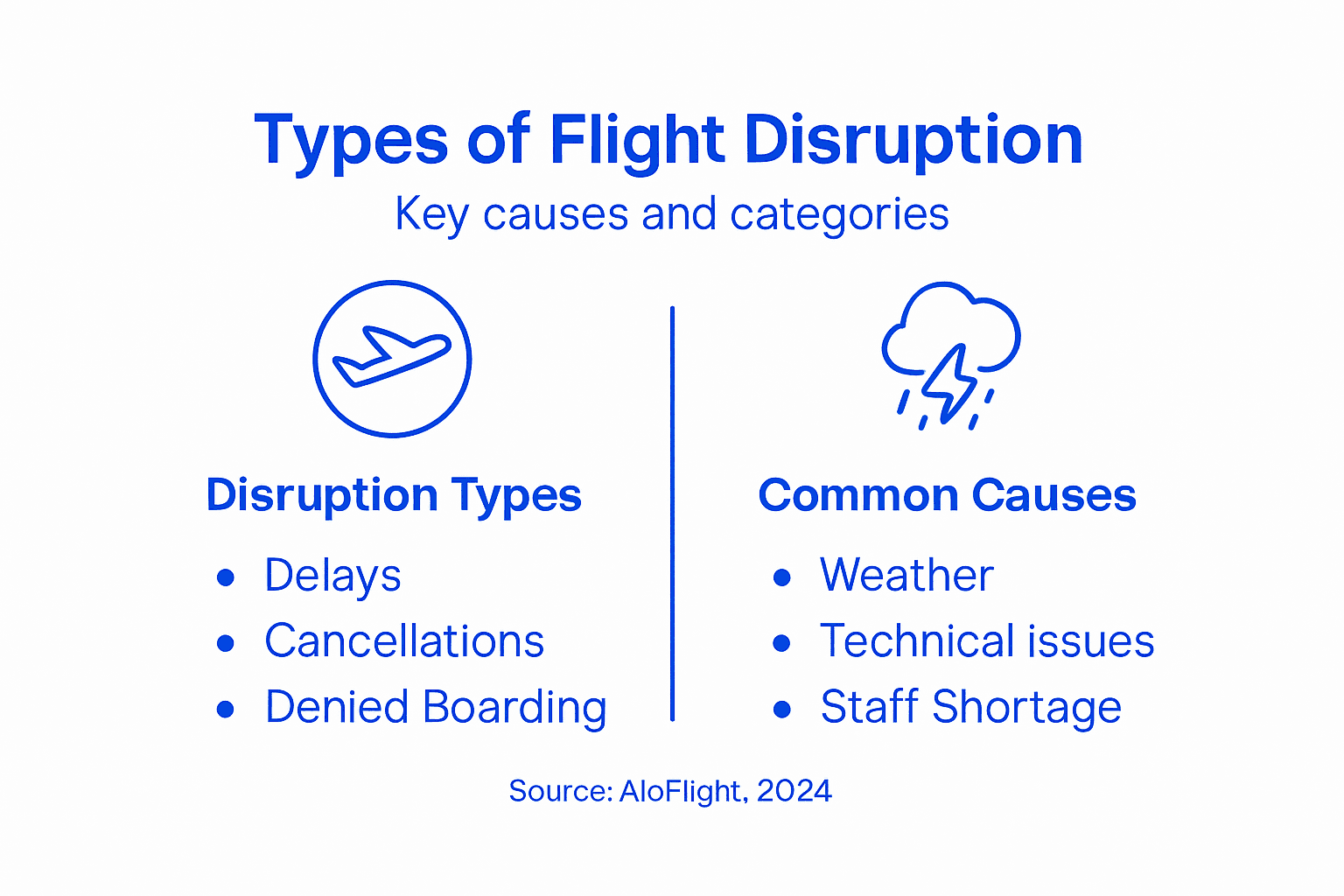
The three main types of disruption are delays, cancellations, and denied boarding. Each has distinct implications for your travel plans and your eligibility for compensation under regulations like EU261.
Delays happen when your flight departs or arrives significantly later than scheduled. A 3-hour delay is frustrating; a 10-hour delay is a day lost. Cancellations mean your flight doesn’t operate at all, forcing rebooking on alternative flights that may not suit your plans. Denied boarding occurs when airlines overbook flights and don’t have enough seats for all passengers.
What triggers these disruptions? The causes break down into several categories:
- Weather-related issues – Storms, heavy snow, fog, or extreme temperatures that make flight operations unsafe
- Technical and mechanical problems – Equipment failures, maintenance issues, or aircraft defects discovered before departure
- Airline operational failures – Staffing shortages, crew scheduling errors, or poor planning that’s within the airline’s control
- Air traffic and infrastructure – Congestion at airports, runway closures, or air traffic control delays beyond the airline’s direct control
- Security and safety incidents – Passenger disturbances, security threats, or unexpected safety protocols
Some causes fall clearly on the airline—a staff shortage or maintenance negligence. Other causes are considered extraordinary circumstances, meaning airlines aren’t liable. Flight disruptions from natural disasters or systemic infrastructure failures present unique challenges that airlines often claim exempt them from compensation.
Here’s the critical part: Common causes include technical problems, staffing shortages, and equipment failures that airlines can sometimes prevent. When an airline had options to avoid disruption but didn’t act responsibly, you likely have a claim.
Weather is tricky. While severe storms are generally considered extraordinary, airlines must still prove the weather directly prevented safe operation. Vague claims of “weather conditions” without specifics often don’t hold up.
Here’s how common causes of flight disruption compare in terms of airline responsibility and compensation likelihood:
| Cause Category | Airline Responsibility | Likelihood of Compensation |
|---|---|---|
| Weather (severe storms) | Generally not liable | Low |
| Technical issues | Often liable | High |
| Crew shortages | Usually liable | High |
| Air traffic delays | Rarely liable | Low |
| Security incidents | Not liable | None |
| Staff planning errors | Liable | High |
The cause of your disruption determines whether compensation is owed—not the inconvenience level alone.
Pro tip: When your flight is disrupted, ask the airline specifically which cause triggered the disruption and request written confirmation. Airlines often cite vague reasons, but written documentation strengthens your compensation claim.
How Flight Disruption Affects Passengers
When your flight gets disrupted, the impact extends far beyond missing your departure time. You’re dealing with cascading consequences that touch your wallet, your schedule, and your peace of mind.
Physical disruption is immediate. You’re stuck at the airport longer than planned, sitting in uncomfortable chairs, dealing with long security lines if rebooking requires a different airline. Your body clock gets thrown off, especially on international flights where time zones compound the chaos.
Financial impact hits harder than most passengers expect. Flight disruptions cause missed connections, extended wait times, and disrupted travel plans that force unexpected expenses on you. Consider what happens:
- Meal and beverage costs while stranded at the airport
- Hotel stays if you’re forced to overnight unexpectedly
- Ground transportation to reach your new departure point
- Lost non-refundable bookings for hotels, car rentals, or tours at your destination
- Potential loss of income if you miss work due to severe delays
Mental and emotional stress accompanies every delayed or canceled flight. Uncertainty kills peace of mind. You don’t know when you’ll actually reach your destination, whether you’ll make important connections, or if you’ll arrive in time for business meetings, family events, or weddings.
Airlines often fail to communicate clearly during disruptions. Passenger stress increases when disruptions lack timely information and clear communication about what’s happening next. You’re left refreshing flight status pages and asking gate agents the same questions over and over.
Domino effects cascade through your entire trip. Miss a connection and you’re rebooked days later. Arrive late to your destination and you’ve lost valuable vacation time or missed critical business opportunities. A single disrupted flight can unravel carefully planned itineraries.
Flight disruption isn’t just inconvenience—it’s financial loss, stress, and disrupted life events compounding simultaneously.
The worst part? Airlines often treat passenger suffering as a minor operational footnote rather than a serious failure requiring compensation.
Pro tip: Keep detailed records of all disruption-related expenses: receipts for meals, hotels, ground transportation, and missed bookings. These costs form the foundation of your compensation claim beyond the standard regulatory amounts.
Legal Rights and Compensation Explained
Your disrupted flight isn’t just bad luck—it’s a legal matter. Passengers have concrete rights to compensation and assistance, though these vary significantly depending on where you are traveling.
European Union passengers have the strongest protections. Under EU261 regulation, you’re entitled to compensation ranging from €250 to €600 depending on flight distance when your flight is canceled or significantly delayed (over 3 hours). This applies regardless of the airline’s nationality, as long as the flight departs from an European Union airport or arrives at one with an European Union airline operating the service.
United States regulations take a different approach. Rather than mandated monetary compensation for delays, U.S. rules focus on passenger care with refunds for canceled flights and accommodations in specific circumstances. Airlines must rebook you on the next available flight or offer a refund, but monetary compensation for delays isn’t federally required—though individual airlines may offer it voluntarily.
Other countries have their own frameworks. Brazil mandates specific assistance and monetary compensation for prolonged delays. Canada, Australia, and other nations have passenger protection schemes with varying compensation amounts and eligibility criteria.
Your compensation rights depend on three critical factors:
- Cause of disruption – Extraordinary circumstances (severe weather, natural disasters) often exempt airlines from compensation, though not always from care obligations
- Flight distance – Longer flights typically qualify for higher compensation amounts
- Airline responsibility – Airlines are liable when disruptions result from their operational failures, not external forces
Passenger rights include options for refunds, rerouting, and compensation depending on regulatory framework governing your specific journey. This is why knowing your departure and arrival locations matters tremendously.
The biggest challenge? Enforcement and awareness. Airlines rarely volunteer information about passenger rights. Most don’t automatically pay compensation—you must claim it.
Your location determines your compensation entitlement; European passengers receive significantly more protection than American ones.
Pro tip: Identify which regulation applies to your flight immediately after disruption occurs, then document everything before airline deadlines expire—most compensation claims have time limits ranging from months to years depending on jurisdiction.
Below is a summary of passenger rights and compensation by region:
| Region | Compensation Rights | Typical Coverage |
|---|---|---|
| European Union | Set monetary amounts (€250–€600) | Delays, cancellations, denied boarding |
| United States | Refunds, rebooking, care rules | Mostly cancellations, limited delay coverage |
| Canada | Fixed amounts based on delay | Delays, cancellations, denied boarding |
| Brazil | Monetary and assistance rights | Prolonged delays, cancellations |
| Australia | Case-by-case, less standardized | Major delays, some cancellations |
Mistakes to Avoid and Recovery Steps
When your flight gets disrupted, your first instinct might be to panic. That’s exactly when mistakes happen—mistakes that cost you money and weaken your compensation claim.
The biggest mistake? Staying silent. Common mistakes passengers make include failure to communicate effectively with airlines and not understanding their rebooking options or compensation rights. Passive acceptance of whatever the airline offers you is a guaranteed path to losing money.
Avoid these costly errors:
- Accepting the first rebooking option without questioning alternatives – Airlines often rebook you on inconvenient flights days later when better options exist
- Ignoring airline communication channels – Missing announcements about gate changes, rebooking availability, or compensation options
- Not requesting written documentation – Verbal promises from gate agents disappear; written confirmation proves what was offered
- Assuming weather cancellations eliminate your rights – Airlines must still provide care (meals, hotels, communication) regardless of cause
- Waiting passively instead of taking action – Airlines won’t initiate compensation; you must claim it
Recovery begins immediately after disruption occurs. First, stay calm and gather information. Ask airline staff specifically what caused the disruption and request written confirmation of the reason. This single document becomes crucial for your compensation claim.
Next, understand your immediate options. Most airlines offer three paths: rebooking on the next available flight, rebooking on a later flight with compensation for care costs, or a refund. Evaluate which serves your actual needs, not the airline’s preference.
Use digital tools whenever possible. Modern airlines provide apps and online portals for rebooking, meal vouchers, and hotel arrangements. Proactive engagement with airline customer service and utilizing digital self-service tools streamlines recovery faster than waiting in queues.
Document everything meticulously. Keep boarding passes, confirmation numbers, expense receipts, airline communications, and photographs of gate information displays. These become evidence supporting your compensation claim later.
Finally, initiate your compensation claim promptly. Don’t wait weeks—most airlines have strict time limits for claims, and enforcement deadlines exist depending on your jurisdiction.
Taking immediate, documented action separates passengers who recover losses from those who accept airline offers without question.
Pro tip: Request the airline’s disruption report in writing immediately—this document establishes the cause and grounds for compensation before the airline revises its explanation.
Take Control of Your Flight Disruption Experience Today
Flight disruptions can be more than just an inconvenience—whether it is delays, cancellations, or denied boarding caused by technical issues or airline operational failures, the resulting stress and financial loss are real. If you have faced these challenges and wonder how to claim your rightful compensation, you are not alone. The key is acting quickly and knowing your rights under regulations like EU261 or U.S. passenger protections.
AioFlight is here to guide you through every step of this often confusing process. Based in London and serving passengers across Europe, the USA, and the world, we specialize in simplifying claims for flight disruptions. Our experienced team ensures transparency and maximizes your chances to recover what you deserve. Don’t let airline excuses or vague reasons prevent you from receiving compensation. Visit AioFlight now and join thousands of satisfied customers who reclaimed their travel peace of mind and financial losses. Start your hassle-free claim today and turn disruption into your advantage.
Frequently Asked Questions
What is considered a flight disruption?
Flight disruption occurs when a planned flight is delayed, canceled, or takes an unexpected route, impacting the original schedule and potentially the passenger’s travel plans.
What are the main causes of flight disruption?
Common causes of flight disruption include severe weather, technical and mechanical problems, airline operational failures, air traffic and infrastructure delays, and security incidents.
How does flight disruption affect passengers financially?
Passengers can incur unexpected costs such as meals and beverages, hotel stays, ground transportation, and losses from non-refundable bookings when their flight is disrupted.
What rights do passengers have when experiencing flight disruption?
Passengers have rights to compensation and assistance that depend on the cause of the disruption and airline responsibility, including options for refunds, rebooking, and monetary compensation in certain circumstances.